

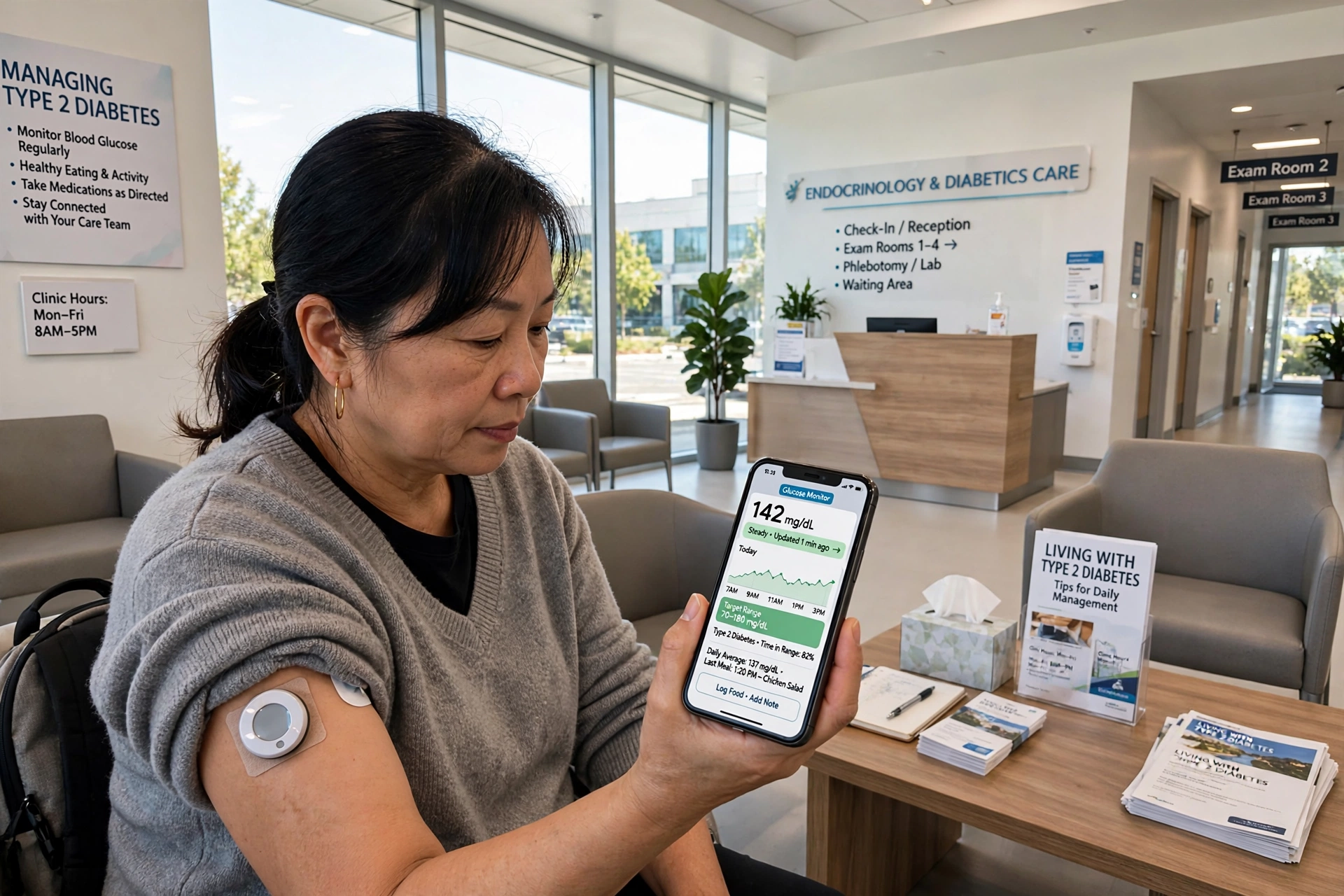
Continuous glucose monitors can help adults with type 2 diabetes who do not use insulin spend roughly five more hours a day with their blood sugar in the healthy target range, according to the largest clinical trial of its kind, published in the New England Journal of Medicine. The findings, summarised by the University of Colorado Anschutz Medical Campus, could widen access to a technology long associated mainly with insulin users.
What the Trial Found
Participants who wore a continuous glucose monitor, or CGM, saw their blood sugar stay in range for about five hours longer each day than those relying on standard care. That is a clinically meaningful difference. Time in range is increasingly used alongside the traditional HbA1c test because it shows the daily pattern of highs and lows that a single average can hide. Fewer hours spent too high means less strain on blood vessels, eyes, kidneys and nerves over time, while fewer crashes mean a safer, steadier day.
CGMs work through a small sensor worn on the arm or abdomen. It measures glucose in the fluid under the skin every few minutes and sends the readings to a phone or reader, complete with trend arrows showing whether levels are rising or falling. Instead of a handful of finger-prick readings, patients and clinicians get a near-complete picture of how meals, activity, sleep and medication shape blood sugar across the whole day.
Why It Matters for People Not on Insulin
Until now, coverage and clinical guidance for CGMs have focused heavily on people who inject insulin, because their risk of dangerous lows is highest. Yet most people with type 2 diabetes do not use insulin, and they are often the ones with the least feedback about what is actually happening between clinic visits. This trial suggests the feedback itself is powerful: seeing a post-meal spike on a screen, in real time, changes behaviour in ways that general advice rarely does.
The result fits a wider pattern in diabetes care, where steady daily habits matter as much as medication. Our earlier coverage of how a Mediterranean diet and exercise can prevent type 2 diabetes pointed in the same direction, and so does research on healthy ageing and mental decline: small, visible, repeatable improvements compound.
A Shift in How Diabetes Is Measured
For decades, diabetes management has been judged mainly by HbA1c, a laboratory test that reflects average blood sugar over roughly three months. It remains important, but averages can be misleading: a person can have a reassuring average while swinging daily between sharp highs and uncomfortable lows. Time in range was developed to capture that lived reality. International guidance generally treats more time between 70 and 180 milligrams per decilitre as better, and every extra hour in that band is an hour in which the body is under less metabolic stress.
That is why a gain of about five hours a day attracted so much attention. It is not a marginal statistical movement; it represents a large share of a person’s waking life moving from out-of-range to in-range. Researchers also note that continuous data can reveal problems that visit-based care misses entirely, such as overnight highs, dawn rises in glucose, or the delayed effect of an evening walk. Identifying those patterns allows smaller, more precise adjustments instead of broad changes based on guesswork.
There are still barriers. Sensors must be replaced regularly, supplies can be expensive without coverage, and some patients find constant data stressful rather than empowering. Training matters too: a flood of numbers without guidance can overwhelm. The strongest programmes pair the device with education, so patients learn which patterns deserve action and which are simply normal variation after a meal.
What Patients Should Ask
The study does not mean every person with type 2 diabetes needs a sensor tomorrow. Cost, coverage and personal preference all matter, and a monitor only helps if someone acts on what it shows. But the trial strengthens the case for a conversation. Patients can ask their clinician whether a trial period with a CGM would help set targets, which range is right for them, and how the readings should change their food, activity or medication routines.
Clinicians, for their part, get far better data for those conversations. Instead of adjusting treatment based on one laboratory number every few months, they can see patterns week by week and intervene earlier. As reporting in the New England Journal of Medicine continues to shape practice, expect insurers and health systems to revisit who qualifies for these devices. Five extra hours a day in range is not a cure — but multiplied across months and years, it is exactly the kind of quiet improvement that changes long-term outcomes.

