

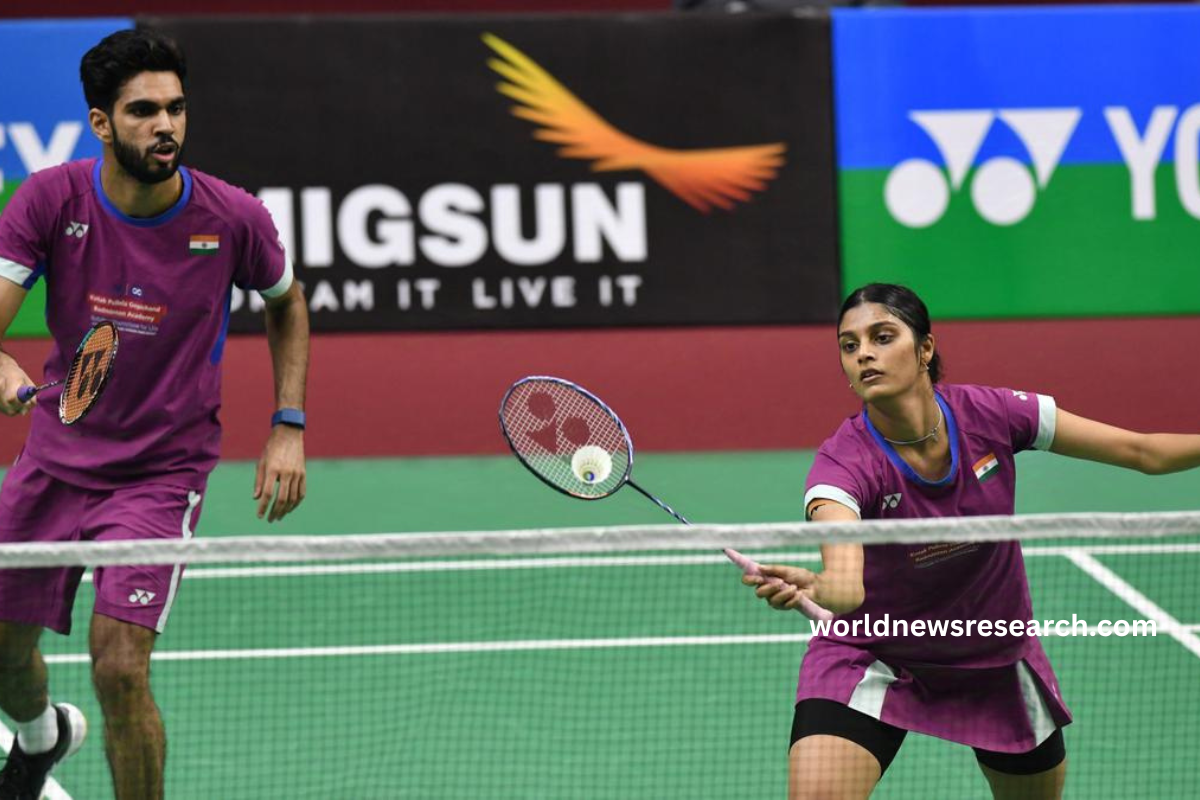
For years, Indian badminton has been defined by standout individual achievements. Saina Nehwal’s grit, PV Sindhu’s commanding presence, and Kidambi Srikanth’s firepower have been the cornerstones of India’s global badminton identity. In recent times, the explosive rise of Satwiksairaj Rankireddy and Chirag Shetty in men’s doubles has added depth and excitement to the country’s badminton narrative. Yet, amidst all this success, one discipline has consistently lagged behind — mixed doubles. Despite occasional flashes of promise, it has largely remained underdeveloped and overshadowed, with limited success on the world stage. Mixed doubles, often crucial in team competitions, has long been considered India’s weakest link — a category lacking the investment, structure, and consistent partnerships seen in singles or same-gender doubles. However, the recent emergence of Tanisha Crasto and Dhruv Kapila offers a promising shift in that narrative, bringing new hope to a discipline once treated as an afterthought.
The Historical Struggles in Indian Mixed Doubles
Mixed doubles has traditionally lagged behind in India’s badminton ecosystem. The last notable high point dates back over a decade to the trailblazing partnership of Jwala Gutta and V Diju, who broke into the world top 10 — a feat unmatched since. While their synergy on court briefly hinted at India’s potential in the discipline, the momentum was not sustained. Limited resources, lack of specialized coaching, and shifting focus toward other categories meant that mixed doubles remained a peripheral endeavor rather than a core focus.
The brief yet exciting pairing of Ashwini Ponnappa and Satwiksairaj Rankireddy brought back hope, but the duo eventually went separate ways to focus on their primary doubles disciplines — Ashwini with women’s doubles and Satwik with men’s.
In major international team events like the Sudirman Cup or the Thomas & Uber Cup, mixed doubles has often been treated as a virtual walkover for the opposition. For years, this segment has been India’s Achilles heel, a category in which fans and analysts alike had tempered expectations.
That was, until 2025.
A Stunner in China: Tanisha-Dhruv’s Breakthrough
At the 2025 Sudirman Cup, held in the Chinese city of Suzhou, something unprecedented unfolded. In a must-win group tie against Indonesia, a traditional badminton powerhouse, India’s only victory came from the most unexpected quarter: mixed doubles.
Tanisha Crasto and Dhruv Kapila, an emerging pair still gaining footing on the world stage, delivered a stunning three-game victory to open the tie. It was more than just a win — it was a statement. A match that might have seemed like a formality in the past now became a contest of grit and chemistry, and India was on the winning side.
“It was amazing. Dhruv and I pulled out a really good win,” Tanisha told ESPN. “We wanted to beat that pair because we lost to them at the German Open semis — a match that was close till the very end [21-19 in the decider]. We were really happy to score the first point for the team. It gave us a lot of motivation.”
For Dhruv, the match had added significance. “We didn’t start well against Denmark [in an earlier tie], and we knew we had to push ourselves,” he said. “We thought, whatever happens with the team, it’s secondary — we have to start in a positive way against Indonesia.”
The win was more than a morale boost. It signaled a shift — a glimpse of a future in which mixed doubles could no longer be considered India’s weakest link.
The Players Behind the Breakthrough
Dhruv Kapila: A Prodigy Rediscovered
Born in Punjab, 25-year-old Dhruv Kapila’s tryst with badminton began early. A standout talent, he joined the prestigious Gopichand Academy at the age of 10. While his foundational years were shaped by intense training and a strong work ethic, Dhruv’s journey was anything but linear.
Though he harbored a natural inclination toward mixed doubles, the lack of a consistent partner forced him to shift his focus. Teaming up with MR Arjun, Dhruv found success in men’s doubles, reaching India No. 2. But injury setbacks to Arjun left Dhruv in limbo, searching for a new direction and a new opportunity.
That opportunity came in the form of Tanisha Crasto.
Tanisha Crasto: A Journey Across Continents
At just 22, Tanisha’s journey to Indian badminton is as unconventional as it is inspiring. Born and raised in Dubai, she had always dreamt of playing for India. At 16, she made the bold decision to leave the comfort and familiarity of her home to train in Hyderabad, the heart of India’s badminton revolution.
Tanisha’s early promise in mixed doubles was evident. She formed a rising partnership with Ishaan Bhatnagar, and the duo were being groomed for long-term success. But fate intervened when Ishaan suffered a serious knee injury, forcing Tanisha to reassess her trajectory. She shifted to women’s doubles, partnering with Ashwini Ponnappa, and eventually qualified for the Olympics — a testament to her adaptability and talent.
Still, her heart was in mixed doubles, and when paired with Dhruv, things clicked almost instantly.
On-Court Chemistry: More Than the Sum of Their Parts
Tanisha and Dhruv are, on the surface, vastly different — in personality, background, and playing style. But that difference is precisely what makes their partnership work.
Dhruv brings control, tactical awareness, and an ability to read the court. He sets the tempo, creates space, and often dictates the flow of rallies. Tanisha, meanwhile, is the aggressor, quick at the net, fearless in attack, and always looking to disrupt the opposition’s rhythm.
Their contrasting styles have created a dynamic blend — a balance of aggression and patience, instinct and planning. They’re still a work in progress, yes, but their potential is evident in every match they play.
Breaking the Glass Ceiling: The Significance of Their Rise
The rise of Tanisha-Dhruv isn’t just about another Indian pair performing well. It’s about what they represent: a new direction for Indian badminton.
For years, mixed doubles has suffered from systemic neglect. While top singles and men’s doubles players received coaching, funding, and international exposure, mixed doubles pairs were often sidelined. With Tanisha-Dhruv’s rise, the narrative is changing.
Their results — including deep runs in international tournaments and wins against higher-ranked opponents — are forcing administrators to rethink their priorities. A long-term plan for mixed doubles development may finally be on the horizon.
What Makes Them Special?
Several aspects of the Tanisha-Dhruv partnership stand out:
- Resilience: Both have faced setbacks — injuries, lost partners, missed opportunities. Yet, they’ve emerged stronger.
- Rapid Improvement: In just a year, they’ve gone from an experimental pair to giant-killers.
- Game IQ: Their ability to adapt mid-match is impressive. They don’t just stick to a Plan A.
- Work Ethic: Both players train relentlessly, often pushing beyond scheduled sessions.
Challenges Ahead
Despite their recent successes, the road ahead is not without obstacles:
- Injury Management: Dhruv’s previous partner, MR Arjun, was plagued by injuries. Careful workload management is key.
- Consistency: Beating top pairs once is impressive. Doing it regularly is the real challenge.
- Support System: They need dedicated coaching, analytics, and exposure to global training setups.
The Road to Paris and Beyond
With the Paris 2024 Olympics behind them, the focus now shifts to long-term consistency. The goal is clear: qualify for the World Tour Finals, push for a top-10 ranking, and eventually, stand on the Olympic podium.
The badminton world is watching. Coaches are analyzing. Opponents are planning. And India — finally — is dreaming again of mixed doubles glory.
