

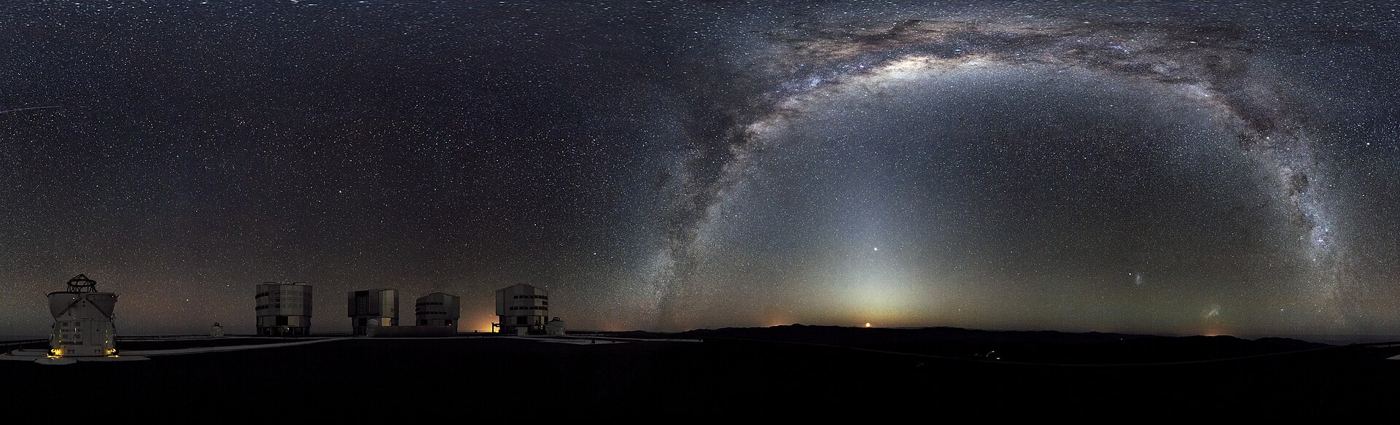
On remote mountaintops in Chile and Hawaii, engineers are assembling telescopes so large that their mirrors span tens of metres, gathering far more light than any telescope that came before them. These giants are designed to look back to the first galaxies that formed after the Big Bang, to watch planets being born around young stars, and to measure the expansion of the universe with new precision. Building them is an extraordinary challenge. Their mirrors are made of hundreds of segments that must be aligned to a fraction of the width of a human hair, and their domes must rotate smoothly while shielding the instruments from wind and dust. Adaptive optics systems, which flex a mirror thousands of times a second to cancel the shimmer of the atmosphere, let them see almost as sharply as telescopes in space. When they open their eyes, they will rewrite parts of the astronomy textbooks.
What the Evidence Shows
The new telescopes will work alongside space observatories rather than replacing them, each covering what the other cannot. Ground telescopes can be far larger and their instruments can be repaired and upgraded, while space telescopes enjoy a clear view above the atmosphere. Together they will study the atmospheres of distant worlds, searching for the chemical fingerprints of water and other gases, and trace how galaxies grew from small clumps of stars into the spirals and ellipticals we see today. They will also hunt for the faint light of the very first stars, which burned briefly and brilliantly before fading away. Construction is slow and expensive, and some projects have faced delays and budget debates, but the science case has kept them moving forward. The first of these giants should begin observing within a few years. Reporting and analysis from sources such as NASA track the same developments, and specialists following the giant ground telescopes peering into the early universe say the direction is now consistent across independent lines of evidence.
The Wider Context
Funding bodies are watching the giant ground telescopes peering into the early universe closely because the work sits at the junction of basic curiosity and practical return. Grant panels increasingly ask for a path from discovery to application, while researchers push back that the most valuable uses of fundamental science are rarely the ones written into the original proposal. The tension is productive when both sides stay honest about timescales.
What Happens Next
The long view on the giant ground telescopes peering into the early universe is that fields advance by accumulation rather than by single announcements. This result adds a solid, checkable piece to a structure many teams are building, and its authors have shared their data so the piece can be tested from every side. That is how the picture eventually becomes reliable enough to act on. You can follow related developments in our coverage of science.
It is also worth remembering how quickly the picture in this area has changed before. Positions that looked settled a few years ago have been revised as new data arrived, and the same humility is appropriate now. The strongest coverage of this subject, and the most useful advice, tends to come from sources that update their views openly when the facts move, rather than defending an earlier position long after it has stopped fitting the evidence available.

