

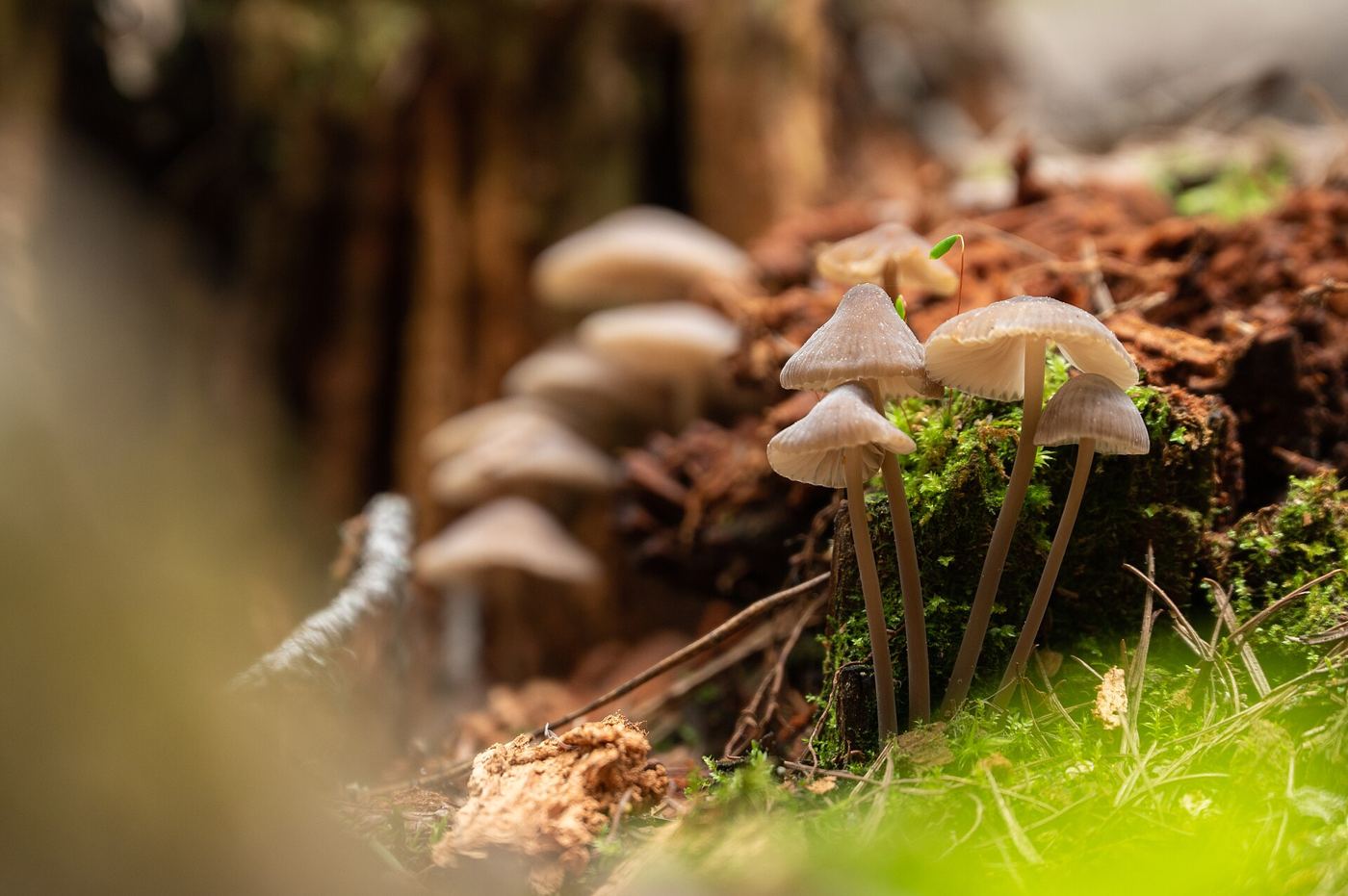
Beneath the floor of a forest lies a hidden network of fungal threads, finer than hair, that connects the roots of trees to one another across whole stands. These fungi trade with the trees: they draw sugars made by photosynthesis from the roots, and in return they supply water and minerals gathered from the soil, reaching places the roots alone cannot. Through this underground web, trees can pass nutrients and chemical signals to their neighbours, and young seedlings growing in deep shade can receive support from older trees nearby. Researchers have traced dyes and labelled carbon moving through the network from one tree to another, showing that the forest is not a collection of rivals but a connected community. The fungi fruit as mushrooms above ground, but most of their lives are spent unseen, weaving the forest together from below. The threads can stretch for kilometres, making a single fungus one of the largest living things in the forest.
What the Evidence Shows
The discovery has changed how scientists think about forests and how foresters manage them. When a tree is attacked by insects, it can send warning signals through the fungal network, prompting neighbours to raise their own chemical defences before the insects arrive. Older, well-connected trees act as hubs, supporting many younger trees around them, and removing them can weaken the whole stand. The network also helps forests recover after fire or logging, since surviving fungi can quickly reconnect new seedlings to the system. Some researchers caution that the popular image of trees deliberately helping one another goes too far, since fungi also serve their own interests. Even so, the evidence for a living web beneath the forest floor has reshaped ecology, and mapping it has become a major field of research. Reporting and analysis from sources such as NASA track the same developments, and specialists following the underground fungal networks linking forest trees say the direction is now consistent across independent lines of evidence.
The Wider Context
Funding bodies are watching the underground fungal networks linking forest trees closely because the work sits at the junction of basic curiosity and practical return. Grant panels increasingly ask for a path from discovery to application, while researchers push back that the most valuable uses of fundamental science are rarely the ones written into the original proposal. The tension is productive when both sides stay honest about timescales.
What Happens Next
The long view on the underground fungal networks linking forest trees is that fields advance by accumulation rather than by single announcements. This result adds a solid, checkable piece to a structure many teams are building, and its authors have shared their data so the piece can be tested from every side. That is how the picture eventually becomes reliable enough to act on. You can follow related developments in our coverage of science.
It is also worth remembering how quickly the picture in this area has changed before. Positions that looked settled a few years ago have been revised as new data arrived, and the same humility is appropriate now. The strongest coverage of this subject, and the most useful advice, tends to come from sources that update their views openly when the facts move, rather than defending an earlier position long after it has stopped fitting the evidence available.

